
Start Here: Owing Tax and Filing Paperwork Are Two Different Things
Most people who search for Wyoming LLC Pakistan tax or Wyoming LLC for non-residents tax want one question answered: do I owe U.S. tax or not? It depends on where you do the work, and that’s what this guide covers. Under the facts below, a foreign-owned single-member LLC run entirely from Pakistan may owe $0 in U.S. federal income tax on its service income. But $0 in tax doesn’t mean there’s nothing to file.
Some sellers pitch these LLCs as a form-it-and-forget-it thing. It isn’t. Instead, think of two buckets: the tax you pay, and the forms and fees you still send in when the tax bill is zero. Anyone looking into Wyoming LLC Pakistan tax rules should keep both buckets in mind. This is general information, not personal tax or legal advice.
Here’s the short chain:
Table of Contents
- The Exact Scenario We’re Talking About
- How the IRS Sees a Single-Member LLC
- Is There a 21% Corporate Tax on My LLC?
- Where Your Service Income Is Sourced
- What Happens When Your Customers Are American?
- Does a U.S. Bank Account Create U.S. Tax?
- Stripe, PayPal, Wise and Other U.S. Payment Processors
- Buying Software and Services From U.S. Vendors
- U.S. Trade or Business, ECI, and Other Tax Terms
- What If You Travel to the U.S. and Work There?
- The $1M Revenue, $850K Expenses, $150K Profit Example
- Does Wyoming Tax Your Income?
- Wyoming Annual Report and the $60 Minimum License Tax
- Getting an EIN Without an SSN
- Form 5472: The Filing You Can’t Ignore
- What Is a Pro Forma Form 1120?
- When Is It Due, and How Do You Send It?
- What Happens If You Miss Form 5472
- Do You Need a BOI Report in 2026?
- Sales Tax Is a Different Animal
- If You Run a UK Visa or Travel Service
- Keep Your Records Clean
- What a Wyoming LLC Costs to Keep Running
- What Could Change Your U.S. Tax Result?
- U.S. Tax Versus Pakistan Tax
- Myths Worth Dropping
- The Short Version
- Questions People Ask
- Official Sources
Everything below rests on a handful of assumptions. If one of them is wrong for you, the answers can shift, so read them slowly.
- One owner, no partners.
- The owner is a nonresident of the U.S., physically in Pakistan.
- The LLC sells remote services, like consulting, an agency, or a travel or visa consultancy.
- No U.S. employees, no U.S. office, no U.S. assets.
- Nobody ever changed the default tax setup.
That’s the full list. For example, your customers can be American. Payments can land in a U.S. bank account. The work itself happens in Pakistan. So if a guide skips these assumptions and just says “no tax,” be careful with it.
Wyoming creates your LLC under state law, but the IRS has no tax category called “LLC.” It asks who owns it and whether you filed anything to change the default. A single-member LLC owned by a nonresident individual is, by default, a “disregarded entity.” In plain terms, the IRS looks straight through the LLC to the person behind it.
You can change that default with Form 8832, which lets the LLC elect to be taxed as a corporation. Most small remote businesses never do. As a result, everything here assumes you didn’t. However, if you did, or you’re thinking about it, talk to a professional before you file anything.
Not by default. The 21% federal rate belongs to C-corporations, and a default single-member LLC isn’t one. You may have seen a page saying your LLC pays 30% federal tax, or that you need Form 8805. In fact, that page is mixing up corporation, partnership, and disregarded entity rules. Form 8805 is a partnership withholding form and doesn’t apply to you.
“Form 1120” is where people get confused. A regular Form 1120 is the corporate income tax return. Your LLC files a pro forma version instead, which is something else, and we get to it below. For now, just know that seeing “1120” on a form doesn’t mean a 21% bill is coming.
This one rule does most of the work. Income from personal services is sourced to the place you physically do the work. IRS Publication 519 explains this place-of-performance rule. In other words, where the client lives, where the contract got signed, which bank received the money: none of it matters.
The chain goes like this:

Service income follows the place where the work is physically done.
If you sit in Lahore, Karachi, or Islamabad and do the job from there, the source is Pakistan. Therefore, the tax answer follows from that. It’s the most useful idea in this whole topic, and a lot of competitor pages skip right past it.
People ask this all the time: do I owe US tax if my customers are American but I work from Pakistan? Going by the sourcing rule, the customer’s nationality or address doesn’t decide anything. Where you did the work does. Also, the IRS uses time-based sourcing, meaning income follows the days or hours of work in each place.
Take three examples:
| Where you worked | Source of the income |
|---|---|
| All the work from Pakistan for U.S. clients | Foreign-source |
| Fly to the U.S. and do everything on-site for a client | U.S.-source |
| Split your time, half in Pakistan and half in the U.S. | Roughly half U.S.-source |
In other words, the split follows where you physically were while working.
No. Does a US bank account make my income US source? It doesn’t. A bank account is just where the money sits, and service income is still sourced to where you did the work.
Say a U.S. client pays you $10,000 and it lands in your LLC’s U.S. bank account. You did that job entirely from Pakistan, so the $10,000 is foreign-source. The account’s location makes no difference to sourcing, and opening it didn’t turn you into a U.S. taxpayer on that money. Also, whether a bank opens an account for you is the bank’s call. No tax rule guarantees it.
Payment processors move your money around. They don’t change the sourcing rule. Getting paid through Stripe, PayPal, or Wise gives you the same result as a wire when it comes to where the income comes from. And like banks, these companies make their own approval and review decisions, so nobody can promise you an account or say it’ll never get frozen.
What does matter, however, is the form you hand them. Processors often ask a U.S. LLC for a Form W-9 by default, and that’s the catch, because a W-9 tells them you’re a U.S. person. A disregarded entity owned by a nonresident foreign individual should generally give a Form W-8BEN instead, which shows the owner is foreign. If you’ve been searching for W-8BEN for a foreign single member LLC, that’s the one.
Paying for U.S. products doesn’t make you taxable there. Hosting, software subscriptions, design tools, any other services from U.S. companies: that’s you spending money, not earning it in the U.S. Generally, it doesn’t count as running a U.S. trade or business.
The word “generally” matters there, though. Your own facts could be different, and an adviser can check them. The basic idea is still simple. Money going out to U.S. vendors is a business expense, and it isn’t a trigger on its own.
These terms come up a lot, so here’s a quick glossary in plain English.
- U.S. trade or business (USTB): regular, active business carried out in the U.S. Physically working there is the usual way you end up in this category.
- Effectively connected income (ECI): income tied to a USTB. It’s the income that gets taxed at U.S. rates for a foreign owner.
- FDAP income: fixed, determinable, annual or periodical income, like certain passive U.S. income. It follows different rules than service income.
- Disregarded entity: what the IRS calls your single-member LLC by default.
- Source of income: where income is treated as coming from. For services, that’s wherever the work happens.
There’s also a fixed foreign office exception under IRC §864(c)(4) that can matter in some edge cases. Don’t lean on it without professional help.
What happens if I travel to the US to work for my LLC? This, however, is the situation that changes things. Any work you do while you’re physically in the U.S. is U.S.-source, even if the client is overseas and the money goes to a Pakistani account.
A narrow de minimis rule exists. It generally involves a stay of 90 days or less and compensation of $3,000 or less, plus other conditions, and those conditions are tight. Don’t plan around it. Instead, if you’re headed to the U.S. for any work-related reason, get advice first.
Let’s put some numbers on it. The LLC brings in $1,000,000 and spends $850,000 on operations, so net profit is $150,000. Income tax works on net income and not gross revenue, which means $150,000 is the figure that counts, not the million.
| Item | Amount |
|---|---|
| Revenue | $1,000,000 |
| Operating expenses | $850,000 |
| Net profit (the figure that counts) | $150,000 |
Now apply the sourcing rule. If every dollar of that work was done in Pakistan with no U.S. presence, the profit is foreign-source, and under those exact facts the U.S. federal income tax on it could be $0. A lot depends on those facts, though. For example, one month of on-site work in the U.S. would change the answer for that slice of income. And the filing duties in this guide apply either way.
Wyoming has no individual income tax and no corporate income tax, which is one reason founders pick it. The state does still charge to keep your LLC active, but those charges aren’t income taxes.
This trips people up. The Wyoming “license tax” is a yearly maintenance fee worked out by formula. It isn’t a tax on profit, and you pay it whether you made $150,000 or lost money. Still choosing between states? Our breakdown of Delaware vs Wyoming compares yearly costs and rules.
The annual report is due on the first day of your LLC’s anniversary month. Wyoming LLC annual report due date anniversary month is a common search, and the rule is easy enough to apply. For example: formed May 15? Due May 1, every year after. Formed March 3? Due March 1.
The license tax has a $60 minimum, and the formula is based on your assets in Wyoming. For a remote business those are usually small, so $60 is typically what you pay. However, bigger Wyoming assets can push it higher.
If you miss the filing, Wyoming can administratively dissolve the LLC after 60 days. Getting it reinstated later takes more time and effort than filing on time would have, so check the Wyoming Secretary of State for current reinstatement terms. For the full year-round picture, see our guide to annual US LLC compliance for foreign owners.
An EIN is the LLC’s tax ID. Foreign owners can apply without an SSN or ITIN by using Form SS-4 and answering line 7b correctly. If you want the steps, we have a separate walkthrough on getting an EIN without an SSN.
People worry about this more than they need to. Having an EIN doesn’t create U.S. tax liability. It works like a CNIC for the business, just an ID number. Your tax result still comes from the sourcing rule, not from holding a number. You will also need the EIN for bank accounts, payment platforms, and the IRS forms below.
If you only remember one form from this guide, make it this one. Form 5472 foreign-owned LLC filings come from IRC §6038A. A foreign-owned disregarded entity has to report certain dealings with related parties even when it owes no tax. The IRS instructions for Form 5472 are where you check the details.
What Counts as a Reportable Transaction?
So what counts? Form 5472 Part V reportable transactions. Putting money into the LLC (capital contributions), taking money out (owner draws), and payments between the LLC and the owner all count. So the question “Form 5472 owner draws capital contribution reportable?” gets a clear yes.
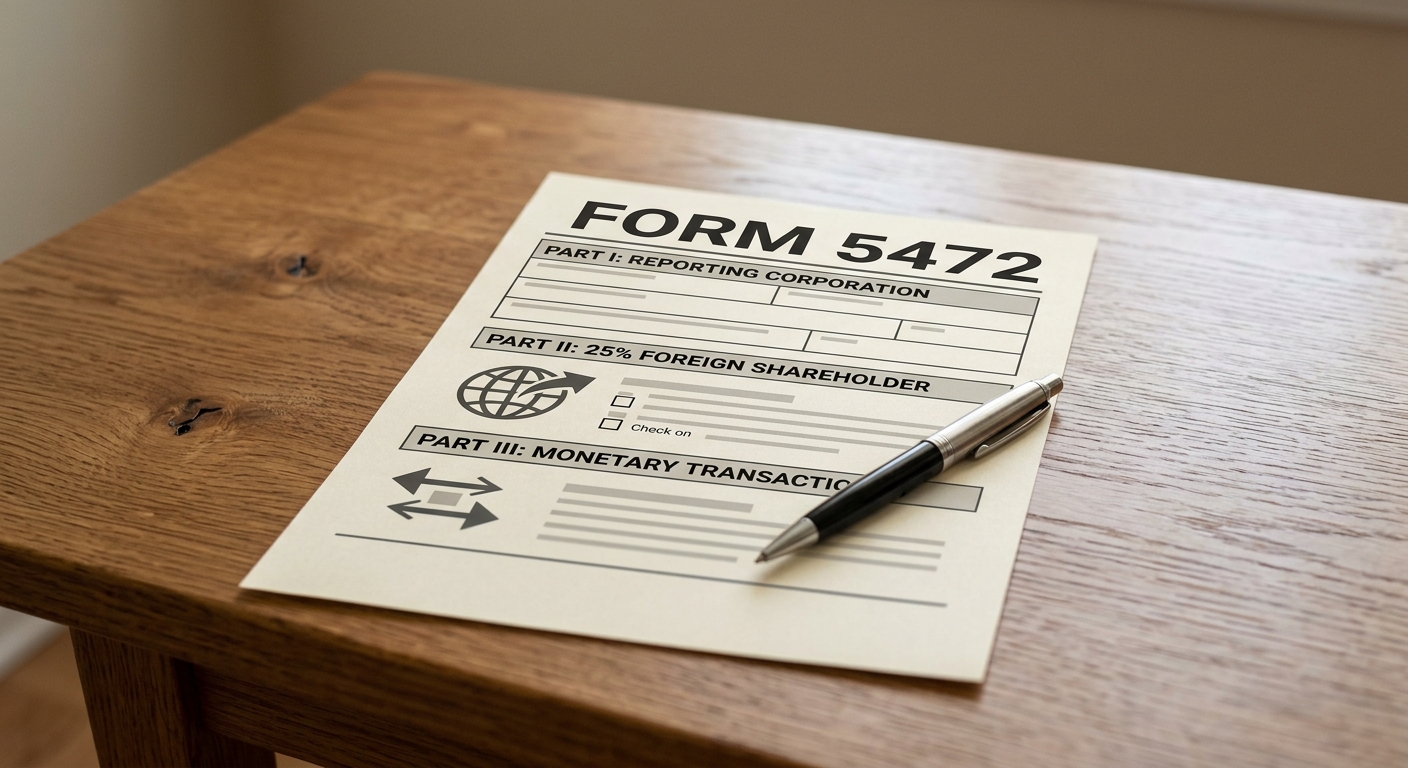
Contributions, owner draws, and related-party payments can all be reportable.
Why Zero Revenue Can Still Mean a Filing
Who Counts as a Related Party?
Related parties are a wider group than you’d expect. For example, under IRC §267(b), family members and Pakistani entities you own can be related parties. In the $850K expense example, if some of that went to your own company or to relatives in Pakistan, each related party can need its own Form 5472. The IRS instructions describe a reporting option around $50,000 and a reasonable-estimate range of 75% to 125%. Therefore, read the current instructions or ask a preparer.
A pro forma Form 1120 is a basic corporate return that a foreign-owned single-member LLC files only as a cover for Form 5472. It carries the LLC’s name, address, and a few items, with “Foreign-owned U.S. DE” written across the top. It isn’t a regular corporate income tax return, and it doesn’t compute any tax.
So the pro forma Form 1120 Form 5472 package goes together. The 1120 is the wrapper and the 5472 is the actual report. You fill in the LLC’s name and address, Items B and E, then write that header note across the top of page one. Also, a preparer who handles foreign-owned LLCs will know how to do it.
For a calendar-year LLC the deadline is April 15. Need more time? Form 7004 gets you an extension. Filing and paying run on separate clocks, so an extension to file isn’t an extension to pay whatever’s owed.
Don’t mix this up with the June 15 deadline for Form 1040-NR, which is a different form for nonresident individuals. Instead, the Form 1120/5472 package follows the April 15 schedule. You also can’t e-file it for a foreign-owned disregarded entity. It goes to the IRS by mail or a dedicated fax number, and since those details can change, check the current IRS instructions for the right address and fax line before you send.
The penalty is $25,000 per failure under IRC §6038A. That number is real, and it’s why this form gets so much attention. If the IRS notifies you and the failure keeps going, another $25,000 can apply for each 30-day period after the notice.
I’m not saying this to scare you. It’s just that the penalty is far bigger than what a preparer might charge, often a few hundred dollars, to file the form. If you missed earlier years, don’t ignore it. The law allows reasonable-cause arguments in some cases, but whether yours qualifies is a question for a qualified preparer, who can also tell you how to catch up.
Do I need BOI report Wyoming LLC 2026? Not for a domestic LLC. FinCEN issued a final rule on August 11, 2026, effective August 14, 2026, that permanently exempts U.S.-formed entities and U.S. persons from Beneficial Ownership Information reporting. Lots of older guides still list BOI as a yearly task, and they’re out of date.
However, only foreign entities registered to do business in a U.S. state remain reporting companies. Your Wyoming LLC, formed in Wyoming, is domestic.
Income tax and sales tax run on different logic. Income tax asks where you did the work. Sales tax depends on where the customer is and whether you’ve crossed a state’s threshold, often called economic nexus. So having $0 federal income tax doesn’t settle sales tax.
Wyoming’s remote seller threshold is $100,000 in sales. Other states have their own rules, and digital services get treated differently from state to state. If you sell to lots of U.S. customers, look instead at the states where they live, not just Wyoming. This guide doesn’t go deep on it, so raise it with a preparer.
Plenty of Pakistani founders run consultancies in areas like UK visa and travel help. In practice these are agency and consulting services, so the tax logic above applies to them like any other remote service.
Tax compliance isn’t permission to practice, though. Filing Form 5472 and paying your Wyoming fee doesn’t authorize you to give licensed advice, such as immigration advice, in the UK or anywhere else. Those rules belong to each destination country and are a separate matter. Xpezia doesn’t give immigration or visa legal opinions, and your LLC paperwork won’t stand in for the right authorization.
The IRS expects records that back up what you report. Treas. Reg. §1.6038A-3 covers record-keeping for foreign-owned entities. If you ever get a question about a related-party payment, your records are what you’ll answer it with.
In the $850K example, for instance, that means holding on to contracts, invoices, and proof the work was actually done. Paid a Pakistani company or a family member? Then keep a paper trail showing what they did and why the amount made sense. Also, keep a ledger with every draw and contribution, dated. It helps with Form 5472 and gives your Pakistani adviser clean numbers to work from. Fixing messy books three years later is no fun for anyone.
Here’s an estimate using assumed prices. Wyoming license tax at the $60 minimum, a registered agent at about $50, and a tax preparer for Form 5472 and the pro forma 1120 at roughly $250 to $400. Add it up and you get about $360 to $510 a year.
| Item | Estimated Annual Cost |
|---|---|
| Wyoming license tax (minimum) | $60 |
| Registered agent | About $50 |
| Tax preparer for Form 5472 and pro forma 1120 | $250 to $400 |
| Total | About $360 to $510 |
Treat that as an estimated maintenance cost, not an official government fee. Only the $60 comes from the state, and the rest depends on who you hire. Prices vary, and a more complicated year (many related parties, say) can cost more. Your Pakistani tax adviser’s fees aren’t in there either. For setup costs on top of this, see our breakdown of US LLC formation cost.
Your answer only holds while the facts hold. Here’s what should make you stop and re-check with a professional:
- Doing work while you’re physically in the U.S.
- Hiring U.S. staff, or opening a U.S. office
- Appointing a U.S. agent
- Buying or holding U.S. assets
- Changing the LLC’s tax classification, for example with Form 8832
- Adding a second owner
- A change in your residency
- Passive U.S. income that falls under FDAP rules
- Payments to related parties you hadn’t reported before
- Selling to customers in states where you cross sales tax thresholds
- A change in the kind of services you sell
You don’t need to memorize the list. However, if something big changes, check again.
Owing $0 to the IRS doesn’t mean owing $0 in Pakistan. Pakistan tax residents are taxed on worldwide income, so what your U.S. LLC earns can still matter to the FBR. In other words, your U.S. tax status doesn’t switch off Pakistani reporting. It also means the draws you take from the LLC, and the profit sitting inside it, may show up in your own FBR declarations. Therefore, ask your adviser how to reconcile them.
Reporting Areas to Raise With Your Adviser
Two areas are worth raising with your adviser. Section 116A of the Income Tax Ordinance 2001 involves a Foreign Income and Assets Statement, with thresholds reportedly around $10,000 of foreign income or $100,000 of foreign assets, so confirm the current figures. Section 109A covers controlled foreign company rules, so ask how it applies to your LLC. Finally, the LLC counts as a U.S. person for FBAR, so if it holds foreign bank accounts, such as in Pakistan, above $10,000 in total, that report may apply.
A few things you’ll hear that don’t hold up:
- “A U.S. LLC means no tax anywhere.” Not true. Pakistan can still tax your worldwide income, and the U.S. side depends on where you work.
- “No tax owed means no Form 5472.” Also not true, since reportable transactions trigger the form, not a tax bill.
- “Form 5472 is required every year no matter what.” Wrong as well. Exception 1 covers years with zero reportable transactions.
- “BOI reports are still due every year for my Wyoming LLC.” Not for domestic LLCs after FinCEN’s 2026 rule.
Finally, nobody can promise you a bank or Stripe account. Tax rules and bank decisions are separate things.
A foreign-owned single-member Wyoming LLC run entirely from Pakistan may owe $0 in U.S. federal income tax on foreign-source service income, because service income is sourced to where the work is done. Where the client is, where the bank is, which payment platform you use: none of that changes it. Physical work in the U.S., however, does.
However, the compliance side is separate. Expect Form 5472 with a pro forma Form 1120 when there are reportable transactions, a Wyoming annual report and license tax every year, and Pakistani FBR reporting handled with your own adviser. Budget about $360 to $510 a year for upkeep and keep clean records. So if your facts change, re-check before you file.
Check these directly, since they’re where the rules are actually set.
Zero Tax Is Great. Missing a $25,000 Penalty Isn’t.
Don’t let a missed Form 5472 cost you more than your whole year’s profit. Get your filings handled correctly and on time by people who work with Pakistan-based LLC owners every day.